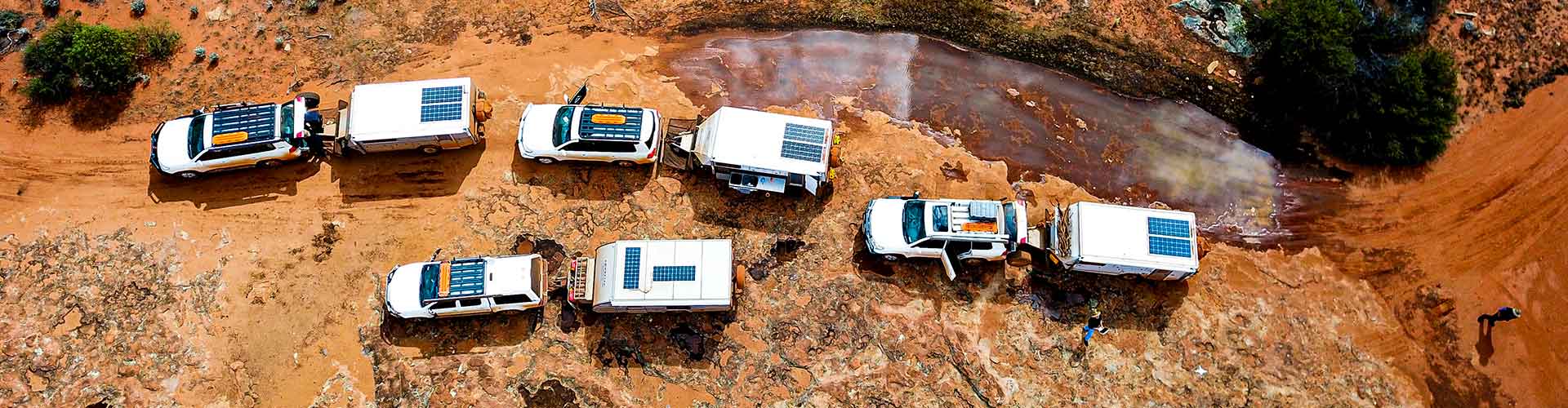
We are back in range after a couple of weeks and at Yulara for a few days. So I thought it worth offering some observations on the first two months of ownership.
Overall a deal more bitumen than we originally planned but it took 3 weeks for us both to get over our bout of Caloundra virus. But despite this we have spent a lot of time exploring swathes of outback Qld and soaking up the local history of each town and region. Totally relaxing and rewarding this slow travel mode
Towing
Not a problem so far either on or off bitumen. See my comments on our little run down the Mereenie Loop for more on off bitumen towing. The disc brake system is superb and we have taken advantage of it more times than I thought we might with errant wildlife and caravan owners pulling out of a roadside stop around 25m in front of you at 110kph.
Comfort and liveability
Great. Really impressed with the insulation we have seen it -4C plenty of times and whilst the heater has also proved its value we have never felt uncomfortable. The weather has also proven the value of having the option to boil a kettle and/or reheat some food without having to go outside
Fuel consumption
We do not hang around and will sit on the legal speed limit on cruise anytime we can. So in the Disco that means 1800RPM and an average of 16’s to the 100km. But we have had some gale force headwinds and seen close to 20’s per 100km at times.. Overall this is exactly the range we expected so not surprised by any of it. As well if we want to get past something we do quickly and safely.
Mereenie Loop Comments
For those who have not driven this road from the Western MacDonnell Ranges around to Kings Canyon the best I can say is respect it every time you lower your tyre pressures before heading on it. It offers a perfect range of off bitumen driving with endless corrugations, long sandy patches, winding sections with blind corners, plenty of OMG creek crossings and bull dust potholes at least 300mm deep and up to 25M long we found. Oh plenty of rocks, wood-de-doos et al. Sort of a 170km combination of the GRR, Oodnadatta track, some Beadell tracks amongst others we have travelled over and yes the Tanami should
be added for its endless corrugations as well. One of the other interesting issues is the design of the road itself. It can have quite steep verge’s which are either sandy or corrugated or both. This can create rather challenging driving moments when oncoming traffic suddenly becomes sideways which is not a pretty sight. Slowing down and sharing the crown of the road in these situations is a nice safe and polite way of trying to avoid a crash.
So pressures. 26F and camper and 28psi in the rears. Speed if you can call it that ranges from barely 20kph up to 90kph at times but not for long.
The creek crossings, whilst dry, ranged from having a bit of bitumen (few indeed) to OMG that is really nasty and having the ABS on to pull the car and camper up fast and straight to wash off enough speed. Herein lies another plus for our ALKO disc brake system.
As 100% of the hire cars and hire 4WD had not lowered their pressures we did quite a bit of overtaking. Given these vehicles were lucky to be travelling faster than 60kph it is a matter of ensuring they know you are there (high beam and fog lights does the trick and you must do that to penetrate the choking dust) and then give them a wide and long berth so as to avoid covering them in rocks and even more dust.. This exercise should only be done with a very long view of the road.
Dustproof?
So do we have a dust proof Q+? Yep looks like it
Shocks/suspension
We put the laser pyrometer on the shocks at the end of the Loop. 49-54C on all except the drivers side outside one which read 69C so we need to know more as to why that may have been. Are those temperatures OK? Yes in my view colder than I had expected by around 20C.
Towing performance
Brilliant in a word. We used this section as a field evaluation process so whilst it was all safe and legal I was not hanging around either. But we sat on the same sort of speeds I would always use on these sort of roads as well. There were times when we found ourselves in the middle of a corner that turned from corrugations to bull dust and sand. The result is a slow drifting moment of car and camper van. Nothing dramatic but not the time to put the brakes on. Liftum foot and all was right again. As well suddenly finding the DIP sign actually should have said STOP or OMG this one is nasty means getting aggressive with the brakes and not once did I need to make any correction to the car as a result of the camper driving us.
Fuel consumption check
Not done as yet but certainly with lower tyre pressures we probably were up a couple of litres to the 100km but more to follow once I sort out the
log book
After doing some walking around the Rock and Olga’s we are heading South the Coober Pedy along the bitumen and from there across to William Ck on the Oodnadatta Track for a 500km or so run to the Flinders to visit some of the properties we will be using during the SA AOR Rally next year
A 10,000km service in Adelaide and to resolve a few minor niggles and install a third LifePO4 batter. Wash and clean up then sort out the garden before heading to Victoria for their Rally
Q+, #688 delivered 22 June 17. D4 tow car.
Thanks for the report, Looks like a great trip. I’d say the shock reading on corrugations was very low. Did you test the shocks on the car. On my initial
test of the Quantum to Cape York I did just that, and found the twin shocks to be much cooler than the car.
Yes, they were significantly hotter in the 90C range which I expected given how ruddy rough the track was. The pyrometer has a new battery and we calibrated
it before leaving Adelaide. So I was quite surprised at the readings myself but I was expecting the twin shocks to perform at a much lower temperature.
The stability the van showed in the conditions made for an incredibly stable and confidence boosting experience I have to say.
Reading the road was incredibly hard as the sun was high and no shadows even from the larger rocks so all of a sudden you would find yourself in the middle
of several loop-de-doos with the car and camper being thrown around from them. Or in the middle of a corrugated ridden corner which suddenly becomes
sand and bull dust which means you gracefully slide sideways a touch but all in a nice straight line. The best way I can describe it is the car and
camper acted in unison like a well engineered machine
At no time did we feel the camper “drive” the car in any way. This to me is another reflection of how well engineered the product is and of course what
a fantastic tow car the D4 makes
Re the shocks, don’t forget that each wheel on the camper is damping the load from 1200kg, the car is much lower. I know what you mean by the corrugations
then sudden dust holes, all in a good day on a bad dirt road. I used to enjoy the six wheel drifts in car and camper, the trick being to gently wash
off speed without too many sudden movements of the wheel, great fun.
I try to set the trailers up so that they do not influence the car in a negative way in any situation, in other words they are responsible for their
own handling and braking, sort of following the car like a faithful puppy. Our formula seems to have worked well to date as most of the trailers handle
really well. Glad you enjoyed the shakedown.
—————————————-
Steve thanks and your description of how you set up the campers is a touch more eloquent than mine but hopefully my comments are in fact reflecting
and reinforcing the AOR setup. Certainly, seems so to us. Yes the drive was a great deal of fun it’s the sort of durability testing you can find time
to enjoy. Tyre pressures played a big role.
—————————————-
Yes understood which is why we took all 4 within a minute of stopping the car. A 20C change is in my experience odd but given the variables may be OK.
All it means at the moment is I take more readings and see what happens
Wow, the Mereenie Loop appears to have deteriorated significantly!
The four times we’ve travelled it including the wet it was quite driveable compared to some..then again the GRR is caravan highway nowadays…
I guess it goes to show that road conditions can change significantly in a short time and not something to be taken for granted…
I guess the formula for success is as always – drive to conditions…
—————————————-
The Mereenie loop road surprised us as well with how corrugated it was.We should have let a little more air out and it would have been more comfortable.
Still – car and trailer came through unscathed. Lesson learnt – dirt road – lots of air out of the tyres no matter how the condition.
—————————————-
No the Loop is in its usual variable state. Never driven it graded in over 30 years and from our perspective it is not overly complex for those who are
used to long distance travel on outback roads of indifferent quality. Whereas most in the high tourist areas have not a great idea of the need for
lower tyre pressures and an “eyes up” driving style. Clearly our idea of highways differs. Last year on the GRR even the grader driver summed it up
as “crap” due to the lack of wet dry seasons. About the only problem we experienced was the oncoming traffic travelling at quite incredible speed and
subsequently covering you with rocks and dust making it impossible to see anything behind them so slow down and pull over to try and stay out of the
way. Nothing new in that anywhere from the GRR to Cape York and all tracks in between. Overall we thought it was OK and about on a par with the major
tracks in SA we travelled up on at the time.
As I have said we were not remotely perturbed by the condition of the road. Despite many of the locals we caught up with at Kings Canyon and Glen Helen
complaining about damaged suspension on all sorts of vehicles. A couple of the 4WD tourist bus drivers had some interesting observations on driving
habits I cannot repeat
Coming up from around mid next week will be a much longer evaluation as we head to William Ck from Coober Pedy then down the Oodnadatta Track to Farina
then some serious rock hopping into some of our favourite Flinders Ranges properties. Only once we have completed that will I be confident we are in
the condition I want for longer duration travel in remote areas. Nothing we have not done before just different having the camper on the back. Should
get us ready for our little sojourn from SA to WA via the Great Central Rd then to the Pilbara via a selected set of back tracks and out of the way,
sort of these days, places. Some of which you recently visited
—————————————-
Yep we treat every dirt road with respect and lowering tyre pressures is always a good start. We drive a lot of the same tracks regularly every year or
so and they are always changing and generally never for the better. Water can’t be taken from underground in certain sections of several SA outback
tracks as it is far too deep, read expensive, to drop the bores any lower. Many many reasons behind this issue! As a result you cannot compact a road
surface and get it to last for very long at all and resheeting them is never going to happen. Add the increasing number of outback travellers and you
have a fascinating cocktail of risk and opportunity.
—————————————-
We travelled the Loop a few weeks ago. We were initially fascinated by the avenue of camel poo for the first 10km which seemed to be regularly deposited
on both sides of the road. It was an interesting drive and good test for the Q+.
Must admit though the road into Chambers Pillar made the Loop seem like bitumen! After that trip we felt we really had put the Q + to the test which it
passed with flying colours.